
Best Rosaries for Everyday Carry: 2026 Guide
Table of Contents
- What Makes a Rosary Suitable for Everyday Carry
- Rosary Comparison Table: Materials, Price, and Design
- Pocket Rosary Options for Compact Prayer
- Cord Rosary Construction: Paracord vs. Chain
- One-Decade Rosary for Simplified Daily Prayer
- How to Carry a Rosary Without Damage or Loss
- Which Rosary Should You Choose
- Frequently Asked Questions
Last Updated: October 11, 2026
What Makes a Rosary Suitable for Everyday Carry
A rosary designed for everyday carry needs to survive real conditions: pocket friction, sweat, accidental snagging, and constant movement. The best rosaries for everyday carry balance durability with portability, combining materials that resist breaking with designs that don't snag on fabric or catch on gear.
What separates a prayer tool from an everyday carry rosary comes down to three core factors: construction method, material resilience, and carry mechanism. Delicate thread frays within weeks; cheap cord corrodes; poorly attached crucifixes snap. Sanctus Co. rosaries are built around materials and methods that hold up to real use, not shelf display.
Practical everyday carry rosaries use paracord or chain construction with heavy-duty beads and secure attachment points. Paracord offers flexibility; chain provides weight and masculine aesthetic. Wooden beads are lighter for pocket carry; stone and brass add durability. A cast brass crucifix outlasts stamped metal or plastic by years.
Rosary Comparison Table: Materials, Price, and Design
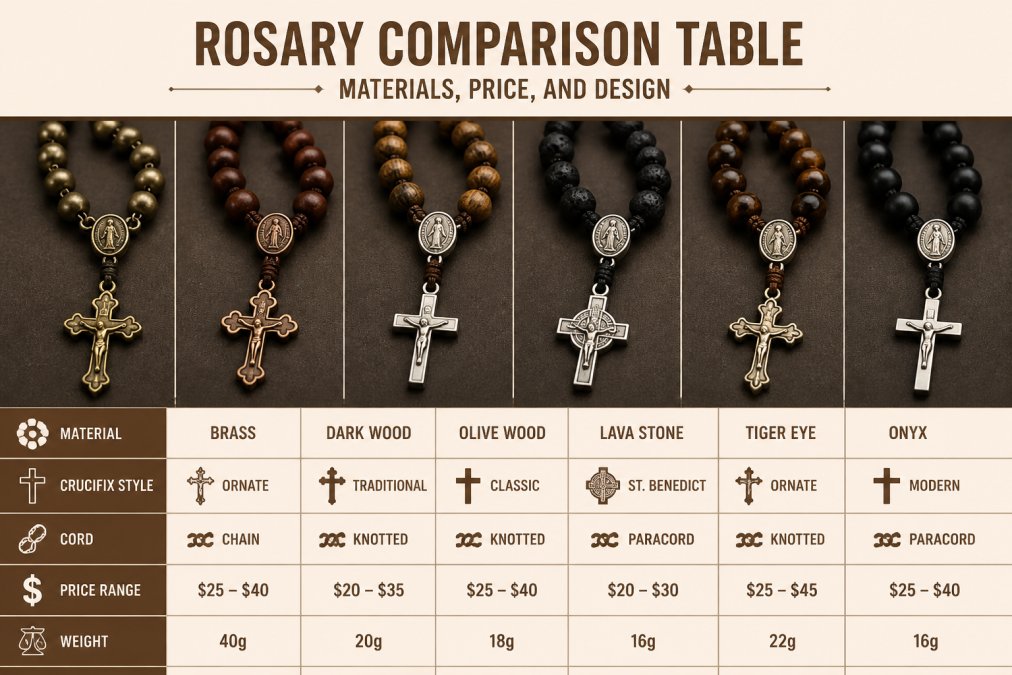
The table below represents the spectrum from budget pocket carry to premium heirloom pieces.
| Rosary Type | Material | Price | Expected Lifespan | Best For | Carry Style |
|---|---|---|---|---|---|
| St. Benedict Rosary - Green | Lightweight brass beads, paracord | $32.00 | 1-2 years (pocket wear) | Testing the practice, budget entry | Pocket-friendly |
| St. Benedict Black Wood Belt Rosary | Wooden beads, paracord, belt hook | $37.00 | 2-3 years (wood can dry/crack) | Warm aesthetic, lighter carry | Belt loop |
| Sanctus Open Carry Belt Rosary | Heavy brass beads, paracord, Japanese hook | $58.00 | 3-5 years (brass resists corrosion) | Durability focus, daily witness | Open carry |
| Sanctus Open Carry Belt Rosary MKII | Heavy brass beads, St. Benedict crucifix, Japanese hook | $58.00 | 3-5 years (reinforced crucifix) | Spiritual practice, everyday use | Open carry |
| Special Edition Belt Rosary - Holy Armament Bright Brass | Solid bright brass beads, premium crucifix | $110.00 | 5-10 years (all-metal construction) | Statement piece, long-term carry | Open carry |
| Sanctus Co X Holy Armament XL - Zebra Jasper | Real stone beads, premium paracord, cast brass crucifix | $133.00 | 10+ years (stone is nearly indestructible) | Family heirloom, multi-generational | Open carry |
| Sanctus Co X Holy Armament XL - Takayama Special | Real stone beads, premium paracord, cast brass crucifix | $133.00 | 10+ years (stone is nearly indestructible) | Premium heirloom, inheritance piece | Open carry |
| Bloodstone Rosary (XL) - Okaja Benefit Beads | African Bloodstone beads, Apostolic crucifix, paracord | $123.00 | 10+ years (stone durability) | Premium carry with charitable mission | Open carry |
How to read this table: Weight over 2 oz. becomes noticeable after 8 hours of pocket carry. Wooden beads require conditioning and can crack in dry climates. Brass beads can tarnish; stone beads are maintenance-free. Cast brass crucifixes outlast stamped alternatives by years. For 3+ years of carry, premium stone options offer better value than budget paracord rosaries.

Material durability in pocket conditions: Paracord can fray; inspect monthly. Wooden beads absorb sweat and can swell. Brass beads on cheap cord corrode. Stone beads are nearly immune to wear. The crucifix is the failure point, stamped metal snaps after 1-2 years; cast brass rarely fails before 5+ years.
Pocket Rosary Options for Compact Prayer
A pocket rosary enables daily prayer in tight spaces without bulk. One-decade designs or compact full rosaries fit inside a pants pocket without visible discomfort.
The St. Benedict Rosary in Green is purpose-built for pocket carry with lightweight brass beads, paracord, and a 3-inch green enamel crucifix. At $32.00, it's the most affordable option for testing pocket carry. Trade-off: no belt hook option.
Pocket rosaries work best where visible religious items invite unwanted attention. The limitation: they can shift, tangle, or work loose during active movement. Some men accept this; others prefer belt-attached security.
Cord Rosary Construction: Paracord vs. Chain
The cord holding your beads determines how long your rosary survives daily carry and how it fails when stress is applied. Paracord and chain are the two dominant construction methods, each with distinct durability profiles and failure modes.
Paracord (550 parachute cord) construction:
Paracord is the standard for everyday carry rosaries because it balances strength, flexibility, and repairability. True 550 paracord has 550-pound breaking strength and distributes stress across knots rather than concentrating it at single points. This flexibility means a rosary pulled sharply won't snap instantly; the cord stretches slightly, absorbing shock.
Paracord's main weakness is fraying at cut edges and gradual stretching. Inspect monthly by running your fingers along the cord. Fuzzing or strands separating from the sheath signal fraying.
Paracord is repairable. For severe damage, remove beads and crucifix and restring on new paracord.
Chain construction:
Chain rosaries use linked metal to connect beads, creating a heavier, more substantial feel. Unlike paracord, chain doesn't stretch, tension goes directly to attachment points and bead holes. This rigidity is both advantage and liability.
Chain won't fray, stretch, or absorb shock, it feels the same after 5 years. The disadvantage: chain concentrates stress at solder joints and bead attachment points. A sharp pull can kink a link or snap a joint. Chain is also more visible in open carry.

Check solder joints monthly by gently flexing the chain. Brass-tone chain can corrode in humid conditions; white or green oxidation indicates corrosion. Unlike paracord, chain cannot be easily repaired at home.
Paracord vs. chain in pocket carry:
Paracord wins for pocket carry: it's lighter, more forgiving, and easier to repair. Chain can kink from pressure, and 3-4 oz. becomes noticeable after a few hours.
Paracord vs. chain in open carry:
Both work for belt carry. Paracord feels modern and practical; chain feels traditional and weighty.
One-Decade Rosary for Simplified Daily Prayer
A one-decade rosary contains 10 beads plus a crucifix, designed for men who want to pray without carrying a full-size tool.
One-decade rosaries work well for busy schedules. A full rosary takes 15-20 minutes; one decade takes 2-3 minutes. You can complete a decade during a work break or before bed. The spiritual practice remains the same: reciting the Our Father, Hail Marys, and Glory Be while meditating on a mystery.
One decade represents only one mystery. A one-decade rosary serves as a gateway to consistent daily prayer.
Most Sanctus Co. rosaries are full-size (five decades), but the pocket-friendly St. Benedict Rosary works well as a one-decade alternative due to its compact design. If you're testing whether daily rosary prayer fits your life, a pocket rosary or one-decade design is the smart starting point.
How to Carry a Rosary Without Damage or Loss
Damage and loss are the two practical concerns with everyday carry rosaries. A rosary tangled in your pocket is annoying; a rosary lost at work is worse.
For pocket carry, keep your rosary in a dedicated pocket away from keys and sharp objects. A coin pocket or inner jacket pocket works better than a pants pocket. Check before washing clothes. Untangle beads weekly to prevent knots from tightening.
For belt carry, secure the Japanese hook firmly to your belt loop so a sharp tug doesn't dislodge it. Tuck the crucifix over your belt to prevent snagging. A rosary worn this way is visible, a bold witness of faith. The trade-off: visibility to coworkers, clients, and strangers.
Wipe paracord rosaries clean with a damp cloth and air dry. Polish brass beads occasionally.
Which Rosary Should You Choose
The right rosary depends on three questions: Where will you carry it? How much are you willing to spend? Do you want your faith visible to others?
For pocket carry under $40, the St. Benedict Rosary in Green at $32.00 is the clear choice, lightweight, durable, and affordable.
For belt carry, the St. Benedict Black Wood Belt Rosary at $37.00 or Sanctus Open Carry Belt Rosary at $58.00 both deliver. Wood is lighter and warmer; brass is heavier and more masculine. Both use Japanese hooks and paracord built to last.

If you want a statement piece that serves as a family heirloom, the Sanctus Co X Holy Armament Special Edition rosaries at $133.00 represent the top tier. Real stone beads, cast brass crucifixes, and premium paracord create a rosary meant to pass to your son or grandson. The investment is substantial, but so is the durability.
If your purchase supports a cause beyond prayer, the Bloodstone Rosary at $123.00 directs proceeds to the Okaja Foundation, supporting Catholic organizations serving vulnerable children. The African Bloodstone beads carry symbolic weight: green and white represent Nigeria's flag, while red represents the blood of martyrs.
Every Sanctus Co. rosary supports the Doloran Fathers' ministry of exorcism and spiritual care. When you carry one of these rosaries, you're not just praying; you're funding priests dedicated to spiritual warfare and pastoral support. That alignment between practice and purpose is what makes Sanctus Co. rosaries more than prayer tools, they're expressions of commitment to living your faith boldly and supporting the Church's mission.
Carrying a rosary daily transforms prayer from something you do at home into a practice woven through your entire day. The best rosaries for everyday carry are built for real use, not decoration. Whether you choose a pocket rosary for discretion or a belt rosary for bold witness, the key is selecting a rosary durable enough to survive daily wear and designed for the carry style that fits your life.
Get started with Sanctus Co. and find the rosary that matches your commitment to daily prayer, spiritual warfare, and visible faith. Our collection of paracord and stone rosaries, supported by the Doloran Fathers' exorcism ministry, gives you a tool built to last a lifetime.
Frequently Asked Questions
What makes a rosary durable enough for everyday carry?
A durable rosary for everyday carry needs strong bead construction (brass, wood, or stone), reinforced paracord stringing, and a secure crucifix. Heavy metal beads and premium 550 paracord resist fraying and breaking under daily use. A solid cast crucifix, rather than hollow components, withstands pocket wear and accidental impacts. Japanese belt hooks provide reliable attachment points for open carry without weakening over time.
Are corded rosaries better for everyday carry than chain rosaries?
Cord rosaries offer distinct advantages for everyday carry. Paracord is flexible, lightweight, and resistant to tangling compared to rigid chains. It absorbs impact better when carried in pockets or attached to belts, reducing bead damage. Cord also adjusts more easily to different carry positions and resists rust and corrosion. For active use and outdoor prayer, paracord construction holds up longer than chain alternatives.
What is the best rosary to keep in your pocket?
The St. Benedict Rosary in Green ($32.00) is ideal for pocket carry. Its lightweight brass beads and compact design fit easily without bulk. The forest green paracord resists visible wear, and the 3-inch St. Benedict crucifix won't snag fabric. Without a belt hook, it's designed purely for pocket storage, making it perfect for professionals or those in environments where open carry isn't practical.
Are one-decade rosaries suitable for everyday prayer?
One-decade rosaries work well for daily prayer when time is limited or portability is essential. They contain one set of ten beads plus an Our Father bead and crucifix, allowing you to pray a single decade anywhere. For Catholics practicing continuous devotion throughout the day, a one-decade rosary complements full rosaries perfectly. They're especially practical for commutes, work breaks, or travel when carrying a full five-decade rosary isn't convenient.
How do you carry a rosary without damaging it or losing it?
Belt carry with a Japanese hook keeps your rosary secure and visible. Attach the hook to your belt loop, tuck the crucifix over your belt, and it stays in place during movement. For pocket carry, keep the rosary in a dedicated pocket away from keys or sharp objects. Store it gently without crushing beads, and check paracord regularly for fraying. If carrying outdoors, inspect the crucifix and bead connections monthly to catch wear early.